
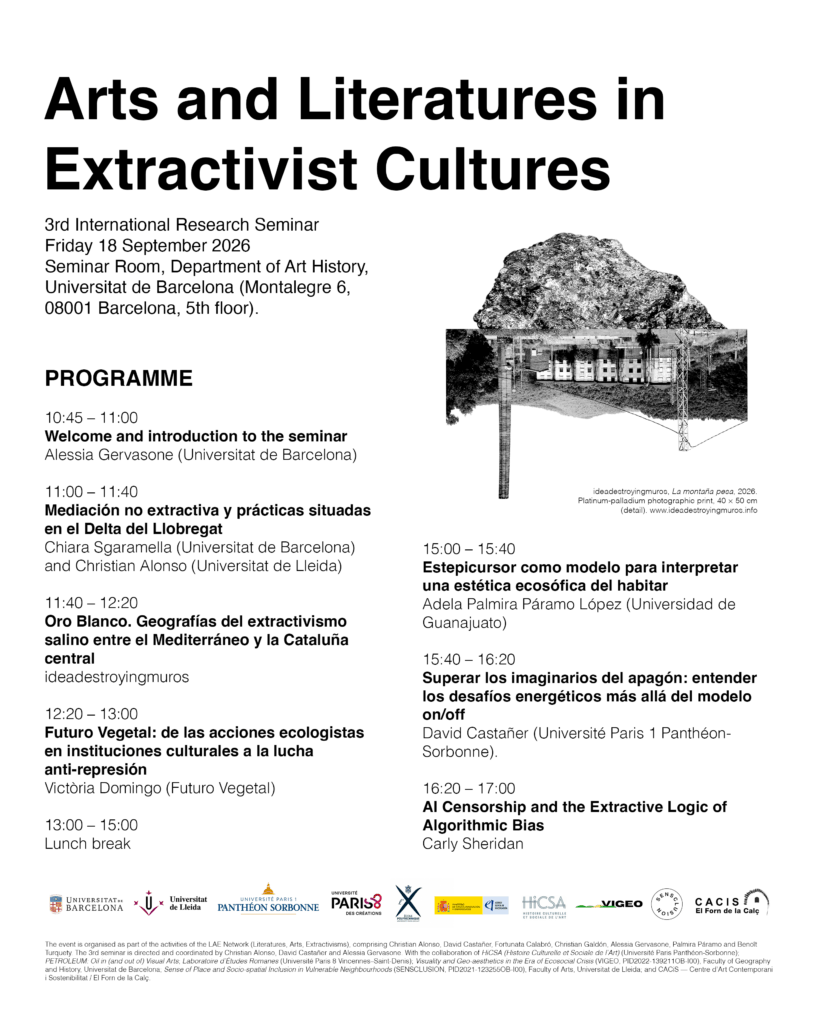
Arts and Literatures in Extractivist Cultures
3rd International Research Seminar
Friday 18 September 2026
Seminar Room, Department of Art History, Universitat de Barcelona (Montalegre 6, 08001 Barcelona, 5th floor).
https://maps.app.goo.gl/yq86zVmjzgVJ8jUe9
The seminar provides a space for exchange between researchers, artists and cultural practitioners who critically engage with the multiple forms that extractivist logics take today. Drawing on perspectives including artistic research, mediation, political ecology, activism, art history and critical technology studies, this third edition pays particular attention to the relationships between cultural practices, territories, infrastructures, ecosocial conflicts and technological systems.
The seminar understands extractivism not only as the exploitation of natural resources, but as a broader logic of appropriation and control that cuts across territories, forms of life, imaginaries and data. Through research projects, artistic practices and experiences of collective action, it will address issues including situated ecologies, mineral extraction, climate activism, energy imaginaries, and the biases and mechanisms of censorship embedded in artificial intelligence systems.
Free and open to all.
PROGRAMME
(Speakers’ biographies can be found below.)
10:45–11:00
Welcome and introduction to the seminar
Alessia Gervasone
(Universitat de Barcelona)
11:00–11:40
Mediación no extractiva y prácticas situadas en el Delta del Llobregat
Chiara Sgaramella (Universitat de Barcelona) and Christian Alonso (Universitat de Lleida)
11:40–12:20
Oro Blanco. Geografías del extractivismo salino entre el Mediterráneo y la Cataluña central
ideadestroyingmuros
12:20–13:00
Futuro Vegetal: de las acciones ecologistas en instituciones culturales a la lucha anti-represión
Victòria Domingo (Futuro Vegetal)
13:00–15:00
Lunch break
15:00–15:40
Estepicursor como modelo para interpretar una estética ecosófica del habitar
Adela Palmira Páramo López (Universidad de Guanajuato)
15:40–16:20
Superar los imaginarios del apagón: entender los desafíos energéticos más allá del modelo on/off
Dr David Castañer (HiCSA, Histoire Culturelle et Sociale de l’Art, Université Paris 1 Panthéon-Sorbonne)
16:20–17:00
AI Censorship and the Extractive Logic of Algorithmic Bias
Carly Sheridan
The event is organised as part of the activities of the LAE Network (Literatures, Arts, Extractivisms), comprising Christian Alonso, David Castañer, Fortunata Calabró, Christian Galdón, Alessia Gervasone, Palmira Páramo and Benoît Turquety. The 3rd seminar is directed and coordinated by Christian Alonso, David Castañer and Alessia Gervasone. With the collaboration of HiCSA (Histoire Culturelle et Sociale de l’Art) (Université Paris Panthéon-Sorbonne); PETROLEUM: Oil in (and out of) Visual Arts; Laboratoire d’Études Romanes (Université Paris 8 Vincennes–Saint-Denis); Visuality and Geo-aesthetics in the Era of Ecosocial Crisis (VIGEO, PID2022-139211OB-I00), Faculty of Geography and History, Universitat de Barcelona; Sense of Place and Socio-spatial Inclusion in Vulnerable Neighbourhoods (SENSCLUSION, PID2021-123255OB-I00), Faculty of Arts, Universitat de Lleida; and CACiS — Centre d’Art Contemporani i Sostenibilitat / El Forn de la Calç.
Speakers’ biographies
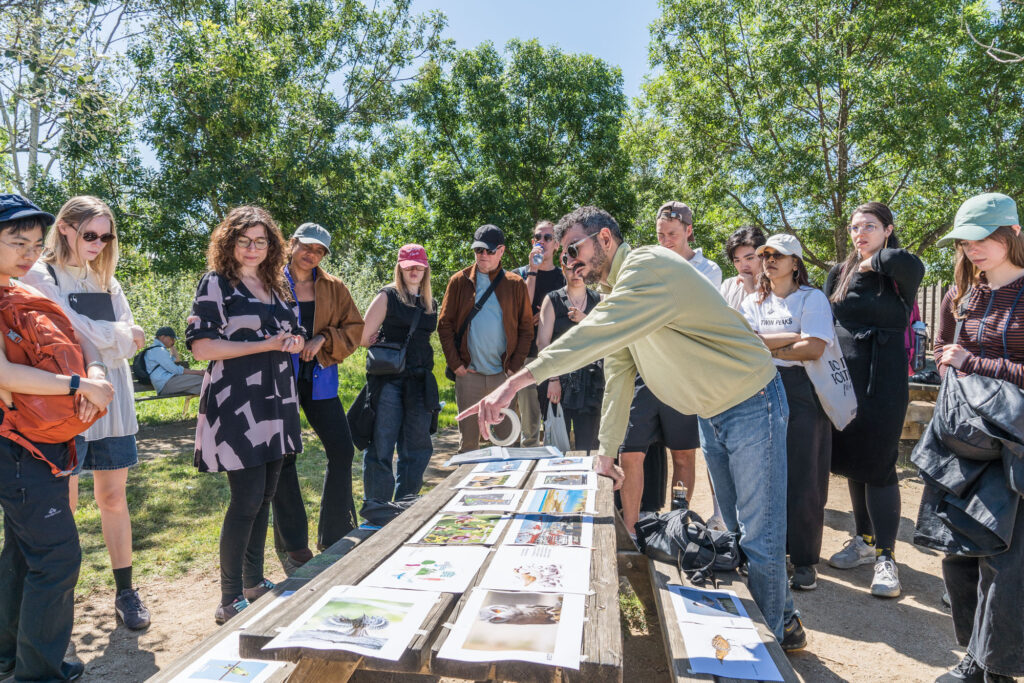
Ecologies Híbrides del Delta del Llobregat is a transdisciplinary research group focused on artistic creation, mediation and experimentation. Its work is situated in the Llobregat Delta, a naturecultural territory of significant ecological and agricultural value within the Barcelona metropolitan area. Despite its environmental and social importance, this ecosystem is threatened by infrastructure expansion, pollution, changes in land use, mass tourism and property speculation. The group’s projects explore relationships of interdependence between human societies and other living species, focusing on research areas including multispecies infrastructures, non-native and invasive plants, sonic hydrologies, more-than-human mobilities, expanded agriculture and food sovereignty. Through artistic practices, collaborative processes and perceptual walks, the group contributes to the development of narratives and forms of knowledge grounded in interspecies care.
https://ecodeltallobregat.org/
ideadestroyingmuros is a transcultural art collective founded in Venice in 2005. Its name refers to the title of Luigi Nono’s composition Voci destroying muros (1970). For more than twenty years, the collective has been based in Valencia while maintaining networks with Italy — Verona and Palermo — and Senegal — Dakar and Thiafoura. Its practice is grounded in community-based artistic creation and situated educational processes, understanding art as a space for encounter, exchange and the collective construction of knowledge. Working from feminist, community-based and post-exotic perspectives, the collective brings together performance, video art, drawing, printmaking, writing, poetry and sewing. Its projects emerge from long-term processes of research and the transformation of everyday experiences, political events and relationships shared with participating communities. The collective has exhibited at museums and universities in Spain, Italy and France, including the CCCB in Barcelona, the CCCC in Valencia and Ecomuseo Mare Memoria Viva in Palermo, among others. In 2021, it received the AVVAC Award from the Association of Visual Artists of Valencia, Alicante and Castellón for Best Art Collective. Since 2019, it has collaborated with the Saperi Situati Laboratory at the University of Verona, Universitat Jaume I and IVAM, developing workshops on community art and education.
https://www.ideadestroyingmuros.info/

Victòria Domingo is a spokesperson and one of the co-founders of Futuro Vegetal, a civil disobedience and direct-action collective campaigning against the climate crisis through the adoption of a plant-based food system. Futuro Vegetal was behind several environmental actions in Spanish museums that received widespread media attention in 2022.
https://futurovegetal.org/
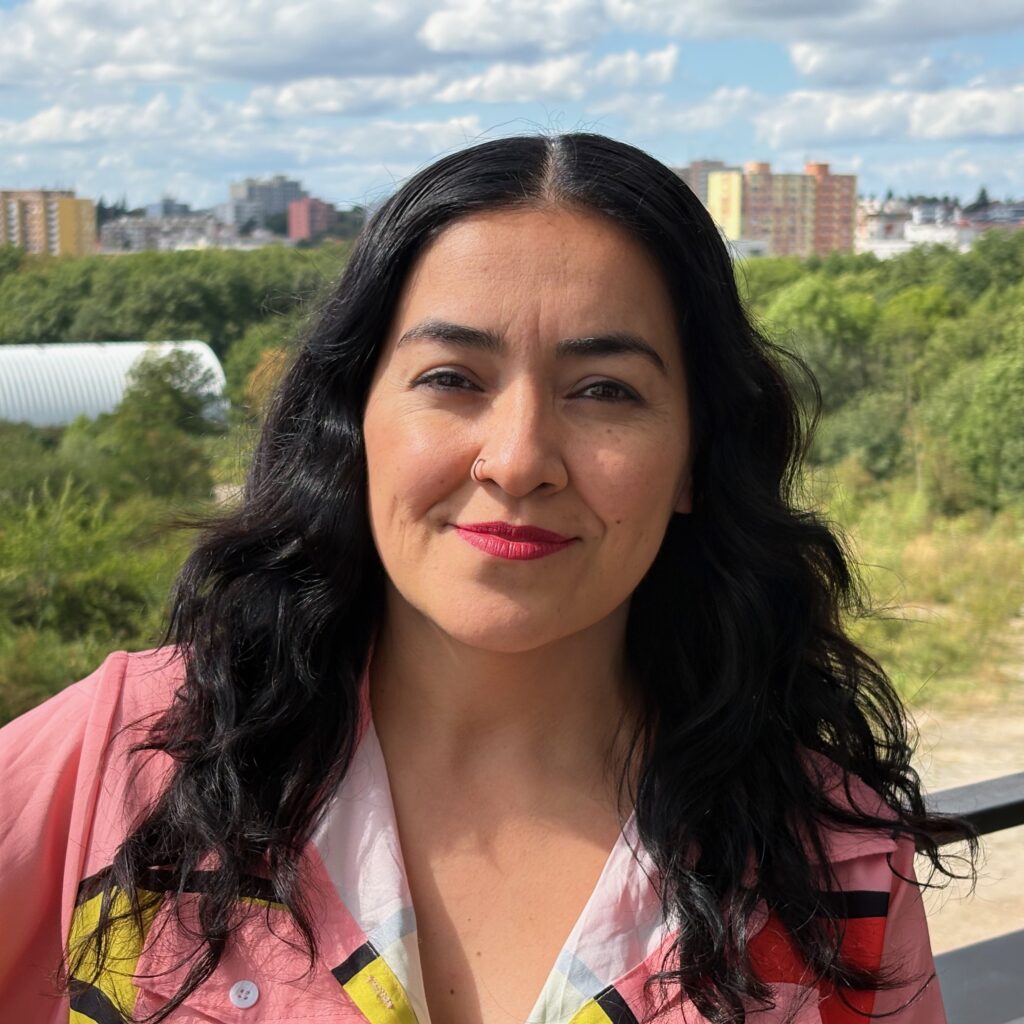
Adela Palmira Páramo López is a researcher, artist, curator, lecturer and cultural manager from León, Guanajuato, Mexico. She is currently undertaking the Interinstitutional Doctorate in Art and Culture at the University of Guanajuato, where her research explores ecosophical aesthetics through artistic practices, continuing her broader line of enquiry into visual arts and critical thought with a particular emphasis on environmental and social issues. Her artistic practice is interdisciplinary, with drawing and nature serving as conceptual and methodological axes. In the fields of curating and cultural management, she is co-founder of Almáciga Gestoría Artística, a project focused on fostering connections between artists and institutions at local, national and international levels, including significant exchanges with Japan through the Contemporary Art Festival Nebula and The Printsaurus. She also co-founded Rizoma Agencia Cultural, an organisation dedicated to promoting the visual arts in dialogue with contemporary literature.
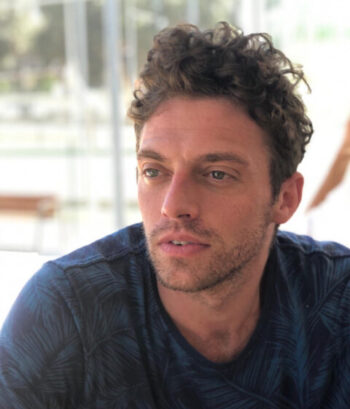
David Castañer is a lecturer and researcher (maître de conférences) at Université Paris 1 Panthéon-Sorbonne. He teaches, in Spanish and French, on modern and contemporary art, literature and critical theories of Latin America. Following a PhD undertaken between Paris and Havana on artistic reappropriations of Afro-Cuban religions in art, he has directed research programmes on the history of Latin American art markets. In recent years, his research has increasingly focused on the connections between the art world and environmental issues, notably through the international programme PETROLEUM: Oil in (and out of) Visual Arts. He has also worked as an independent curator, including at the Dakar Biennale in 2022, as well as a critic and translator, and is currently developing his work in the field of research-creation.
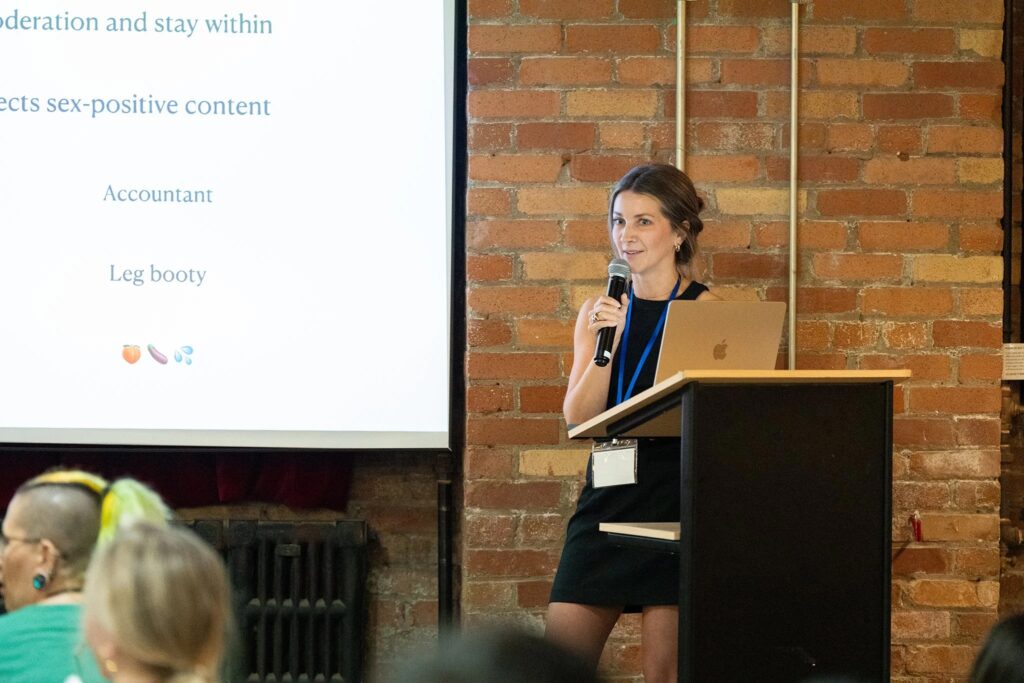
Carly Sheridan (she/her) is a researcher and writer examining the systems that shape our digital lives and the invisible power structures embedded in automated technologies. Her research focuses on the intersection of technology, sexuality, and identity, looking at how technology can reinforce societal biases, particularly around issues of censorship, representation, and access to online spaces. With more than 15 years working in tech, her work moves between critique, research, design, and digital freedom. She holds an MDes in Responsible AI and an MA in Applied AI for Art and Design from ELISAVA Barcelona School of Design and Engineering.